October 23, 2012

Anamed (action for natural medicine) Seminar and Workshop


In March 2012 four people from the Mount Kenya region attended a one-week seminar of anamed international at Machakos. Keith Lindsey and Jutta Krauss of anamed international, Germany, as well as Major Rebecca Nzuki from Machakos District and Tamima Omondi from South Nyanza trained 30 participants from many parts of Kenya. The programme included information about the medicinal use of artemisia, moringa, neem, aloe, garlic and papaya in treating malaria, HIV/AIDS, skin problems and other ailments.

 In practical sessions, the participants made ointments and teas and laid out a medicinal garden. Many other health related topics were covered and the group visited the local anamed group to share their experiences.
 At the end of the seminar the group was visited by the press. One of the seminar participants gave testimony how she had benefited from the use of natural medicine: She had been bed-ridden with AIDS but was now able to lead a self-help group for HIV-positive people and to take part in national forums on that issue.

MKICDO board members at the anamed seminar in Machakos


On April 19th, the seminar participants from the Mount Kenya region conducted their own workshop at CCM Ruguta Church. 

 Anna Gatea of anamed addresses the workshop participants


 They introduced the idea of using natural medicine and encouraged everybody to grow medicinal plants in their own garden/shamba. When hibiscus and lemongrass tea were prepared on a traditional three-stone fire a discussion on the need to save fuel wood came up. The trainers recommended the use of fuel-efficient stoves and demonstrated a Solar CooKit.


wasteful use of firewood


cooking with the sun is a good alternative


The course participants -  some of them school teachers  -  gave a very positive evaluation of the day´s activities and emphasized the need for more such workshops in the future. They founded the Ruguta Christian Concern Group and resolved to hold regular meetings.

the workshop participants

April 6, 2012

The Kenya Agricultural Research Institute (KARI)

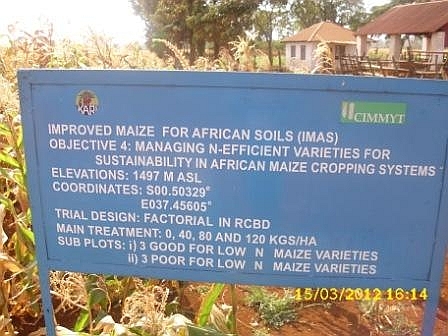
On March15th, the board members went to the Kenya Agricultural Research Institute (KARI) in Embu for a workshop. They were taken on a demonstration tour of the institute´s various projects and given lectures by the respective field experts.
The institute gives farmers information on sound farming practice and provides them with high-quality plant materials and seeds.


a field with sweet potatoes
Christine admires the sweet potatoes that grow bigger when intercropped with cassava.
the 4 a banana can grow 5 times as big as the commonly grown type


sorghum field
Note the paper bags that were put over the sorghum seed heads to protect them from birds.
horticulture: groups of farmers grow flowers for export and market them cooperatively
maintained Moringa plants
plant nursery
drough-tolerant African spinach
a Model zero-grazing unit
The specialist on animal husbandry gives a lecture on balanced cow nutrition.
silage-making
board members in front of the KARI administration building with the coordinator and one of the specialists
 The board members learnt a lot at KARI. They will pass it on to the groups they work with so the members can share this knowledge and the cooperation with the institute. They will be inspired to try new methods and improve their farming practices to the benefit of their families and the whole community.

The Kilimo group

The board members of our organisation have their own groups and projects in their home areas. Christine Murangiri is a member of the Kilimo group at Kabugua near Chuka and also their secretary.
The Kilimo group has established a banana nursery. They have succeeded in growing banana seedlings through a banana tissue method. From this nursery, farmers get a good supply of well-graded plants.
When the bananas are mature the farmers take their harvest to the officials of the Kilimo group and market it cooperatively. Middle men from Nairobi come to collect the bananas and pay for them. The money is deposited into the group´s account and then distributed to the members.

the technician in charge of the banana nursery

weighing the bananas
ready for collection

Soap making

With rising prices for food and household commodities many woman have to struggle to make ends meet. So every opportunity to save or to earn a little extra money is welcome. 
One of the Gaketha group members showed the others how to make soap for their own use. Surplus can be sold and generate a small income.
Micheni shows the ingredients for soap making.
They are mixed together, ...

... stirred ...


... and put in a mould to dry.


Finally the soap is cut into pieces and ready to be used.


March 11, 2012

The shamba project

 In Kenya, the majority of people lives in rural areas. Many of them practice subsistence farming and depend on regular annual rainfalls. In the past, many areas of Kenya have been regularly affected by droughts and crops have dried up. People had to buy their staple foods from the shops which many of them can hardly afford since their incomes are low and the food prices have been driven up by inflation. During "good" rainy seasons the rains often come in heavy downpours: young seedlings are drowned and topsoil is washed away; or insects invade the fields and destroy the crops.

Maize is a Kenyan staple crop. But it needs high amounts of fertilizer and water to do well. Hence maize is among those crops that dry up fast when the rains don´t come at the right time or in sufficient quantity.

Members of the umbrella organization and the Gaketha group have started a pilot project to grow a drought-tolerant sorghum variety. In addition, they will plant sweet potato vines and cassava tree cuttings which they will get from the Kenya Agricultural Research Institute (KARI) in Embu. These varieties will take only 3 months to mature.
Mugo has donated a part of his land for the project. All crops will be grown organically. 


The land has been cleared.


a lesson on contour leveling


A board member learns how to use a spirit level.


Mr. Njue digs terraces along the contour lines.


breaking down the soil for easier planting and germination


adding manure
measuring the distance between the planting holes


cassava cuttings and sorghum seeds from KARI

The tree nursery

The members of the Gaketha group have established a tree nursery. They have been instructed and assisted by Mr. Njue who is an expert in this field. They are going to grow indigenous trees as well as Neem and Moringa. The trees will provide fruits,medicinal herbs, natural herbicides and fungicides as well as firewood and building materials. Planting trees will be an important contribution to preventing further deforestation and counteracting the devastating effects of climatic change. The project also provides an additional source of income for the group members.


The seeds are germinated in seedbeds. The young seedlings have to be protected against the sun with shades.


When the seedlings are strong enough they are transplanted into plastic bags filled with soil. 


Filling the bags is a time-consuming and tiresome job.


On the group´s working day, the members spend the whole day in the tree nursery. Children come along with their mothers. They are welcome helpers and get some environmental training.


strong healthy Neem seedlings


women preparing  food for the group members


an urgent issue: digging a pit latrine for the workers
The hole has to be dug quite deep.
a good example of an easy-to-clean toilet floor  (seen at Kari Agricultural Research Institute)


the Gaketha group


March 10, 2012

School activities

On a project day of Mugo´s school in November 2011, a young teacher and his students  planted tree seedlings in the school compound.


The school is to become an educational centre for the whole community:

- A fuel-efficient stove will be installed in the school kitchen for demonstration.

- The school hall will be used for community training and workshops on environmental issues. 


board members with the headteacher of the school (centre)